FIRST KAVACH-EQUIPPED LOCOMOTIVE FLAGGED OFF FROM ELS-VSKP

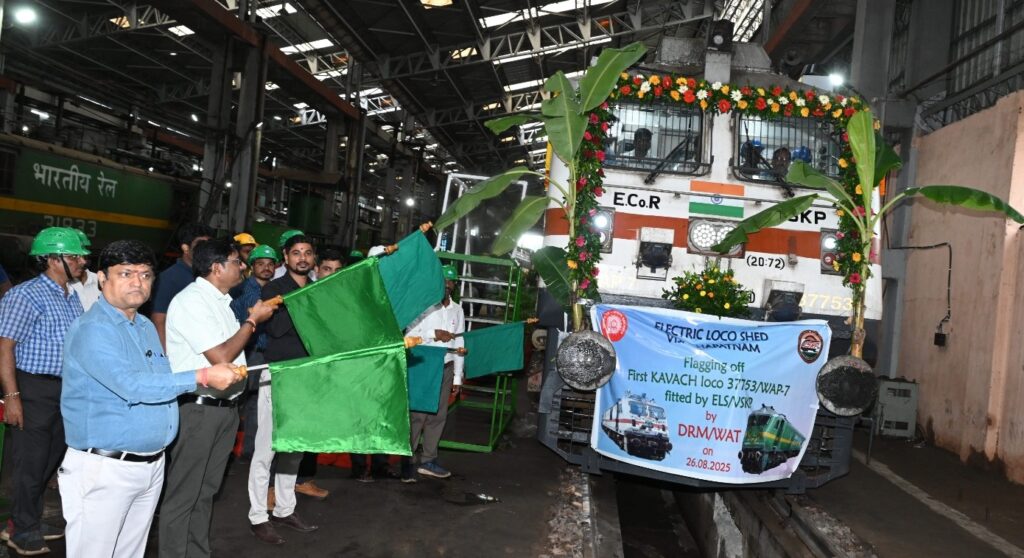
In a significant milestone towards enhancing operational safety on Indian Railways, the first locomotive equipped with ‘KAVACH’ – an indigenous Train Collision Avoidance System (TCAS) – was commissioned and flagged off today from the Electric Loco Shed, Visakhapatnam (ELS/VSKP) today.
‘KAVACH’ is a state-of-the-art safety technology developed indigenously as part of Indian Railways’ mission to provide zero-accident train operations. The system is designed to prevent collisions by providing real-time signal information directly to the loco pilot’s cab. It enables seamless exchange of data between station interlocking systems and locomotives over a secure wireless communication network, while RFID tags mounted on tracks ensure precise locomotive positioning.
To attain the task, Electric Loco Shed, Visakhapatnam has been allotted 186 loco sets with Kavach units for commissioning. The shed has also established a dedicated 600-metre Kavach-compatible test track and installed a ‘station Kavach’ system to facilitate rigorous trials.
Today, Shri Lalit Bohra, Divisional Railway Manager, Waltair, inaugurated the ‘station Kavach’ facility and flagged off the first Kavach-commissioned locomotive — WAP-7, marking a new chapter in railway safety in the region. With this launch, ELS/VSKP has proudly become the first Electric Loco Shed in East Coast Railway to commission KAVACH on locomotives.
Key Features & Benefits of KAVACH:
- Indigenous advanced technology designed to enhance operational safety.
- Automatic protection against head-on collisions.
- Prevention of signal-passing incidents and over speeding-related accidents.
- Reliable and encrypted wireless communication across the section for uninterrupted data exchange.
- Real-time signal and interlocking updates available in the locopilot’s cab.
- Automatic regulation of train speed as per signal aspects, ensuring strict adherence to safety norms.
- Continuous assistance to loco pilots, enabling safe and efficient train operations even at higher speeds.